Industry News
Content
In the fields of construction and residential maintenance, the reliability of gas delivery systems remains the core of safety. Historically, traditional black iron pipe has been the industry standard. However, as architectural designs become more complex and demands for installation efficiency increase, the inherent drawbacks of rigid piping—such as its weight, difficulty in bending, and long construction cycles—have become increasingly prominent.
To overcome these limitations, the industry is undergoing a comprehensive transition from rigid piping to high-efficiency, easy-to-install flexible gas piping. This shift not only improves construction safety but also significantly reduces labor costs, making gas system routing as flexible as electrical wiring. Against this backdrop, high-performance delivery materials have become paramount, and the core of this innovative solution is the industrial standard we will discuss next: corrugated stainless steel tubing.
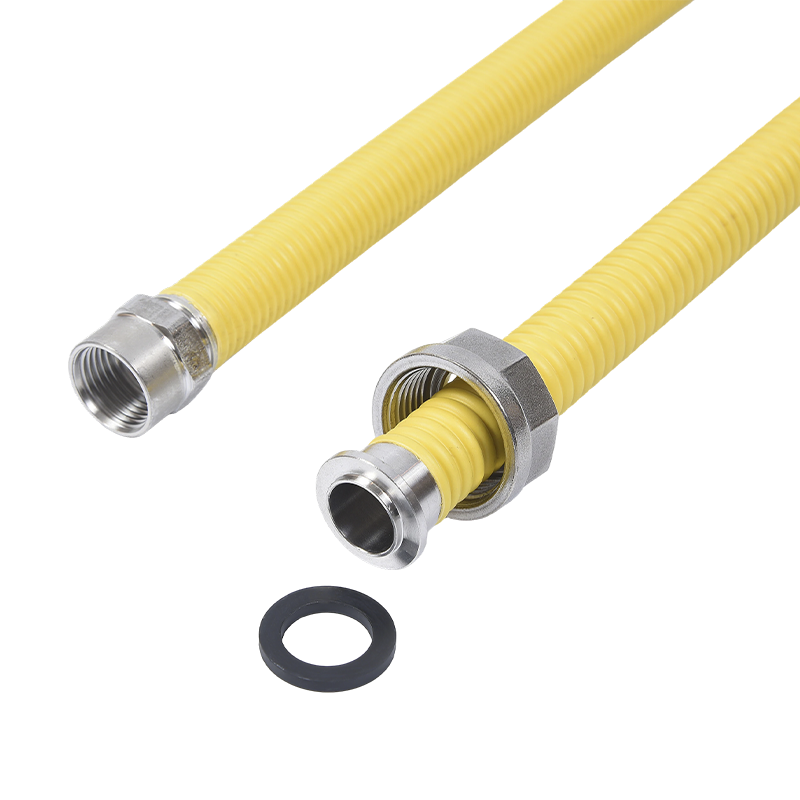
Corrugated stainless steel tubing (CSST) is a flexible system specifically designed for transporting natural gas or liquefied petroleum gas. It is manufactured from highly resilient stainless steel, and its unique corrugated structure allows it to maintain high-pressure tolerance while possessing excellent bending capabilities.
This corrugated stainless steel gas pipe typically consists of two parts: an inner flexible corrugated stainless steel layer and an outer protective jacket made of durable polyethylene, which prevents chemical corrosion or abrasion on construction sites. Compared to traditional rigid steel pipes, CSST can easily be routed through building joists and walls without the need for tedious cutting, threading, or numerous pipe fittings.
When selecting a piping system, engineering reliability and long-term maintenance costs are decisive factors. Stainless steel gas pipe outperforms traditional rigid piping in several technical dimensions. The following is a core parameter comparison between the two:
| Performance Metric | Traditional Black Iron Pipe | Corrugated Stainless Steel Tubing (CSST) |
| Installation Flexibility | Low; requires cutting and threading | Very high; bends with building structure |
| Connection Count | High (each segment requires fittings) | Low (connected only at termination points) |
| Seismic Performance | Average; rigid interfaces prone to breaking | Excellent; flexible structure absorbs vibration |
| Installation Time | Long; requires multiple workers | Short; routing can be completed by one person |
| Corrosion Resistance | Medium; prone to rust, requires coating | Excellent; stainless steel is naturally resistant |
Another significant advantage of corrugated steel gas pipe is its seismic performance. In regions prone to earthquakes, building structures undergo minor shifts, and rigid pipes often fail at joints due to their inability to dissipate stress, leading to leaks. The corrugated geometry of CSST allows the pipe to compress, expand, and bend within limits, significantly reducing the risk of gas leaks after seismic events. Furthermore, because of its smooth inner wall, corrugated stainless tubing has relatively low fluid resistance, allowing it to transport gas from the main valve to terminal equipment more efficiently.
In modern residential and commercial projects, the application of flexible gas tubing has long surpassed simple repair work. Whether it is installing gas main lines for new homes, or supplying gas to kitchen cooking equipment, fireplaces, and outdoor grills, CSST demonstrates unparalleled adaptability.
In narrow attics, basements, or multi-curved wall cavities, traditional rigid pipes are nearly impossible to install. Using corrugated stainless steel gas pipe, installers can easily route the line to the target point just like electrical wiring, avoiding the dilemma of having to abandon a gas equipment installation due to spatial constraints.
Although the unit material cost of CSST may be slightly higher than standard black iron pipe, the comprehensive cost is often lower. This is primarily due to improved installation efficiency—fewer joints mean lower labor costs and significantly reduced risks of gas leaks caused by improper connection installations.
In summary, corrugated steel gas tubing represents a technological advancement in the current gas engineering field; it is not just an upgrade in material, but a simplification and optimization of the entire gas installation process.
The installation of corrugated stainless steel tubing (CSST) differs fundamentally from traditional threaded pipe installation. While its flexibility significantly simplifies the construction process, this flexibility also requires installers to strictly adhere to specific safety guidelines. Incorrect installation methods can not only compromise the system's airtightness but also create safety hazards in extreme environments.
In all installation specifications, the most critical step is equipotential bonding. Because metal pipes can generate arcs when struck by lightning (whether a direct strike or nearby induced lightning), which can melt through the corrugated pipe wall and cause leaks, electrical safety standards require reliable bonding when installing such systems.
Professional Grounding: A qualified electrician must install an effective electrical connection at the gas inlet point, connecting it to the building's grounding system to ensure the pipe potential remains consistent with the earth.
Prohibition of Substitution: It is strictly forbidden to use the gas pipe itself as a grounding conductor for electrical circuits.
Professional installation must follow these key steps to ensure the long-term performance of stainless steel gas hose:
Pipe Diameter Assessment: Before installation, the correct inner diameter must be determined by comparing the equipment’s rated input power (BTU/h) and the routing length against manufacturer-provided flow charts. It is strictly forbidden to reduce the diameter to save costs, as this will lead to insufficient gas pressure at the equipment.
Strict Bend Radius Control: While corrugated stainless steel tubing is flexible, it cannot be bent excessively. Excessive bending reduces wall thickness or causes stress fatigue. The principle is to always maintain a bend radius greater than 3-5 times the pipe diameter.
Fitting Installation: Corrugated steel gas pipe must be used with dedicated mechanical fittings. During installation, ensure the metal sealing ring is intact and use the specified tools to tighten. Forcing a twist on the interface is prohibited, as it destroys the seal.
Pressure Testing: After the pipe is laid, a rigorous pressure test is required. Usually, air or nitrogen is used for a pressure-holding experiment to ensure no drop in pressure occurs over a set period, confirming the system is leak-free before turning on the gas.
| Parameter Item | Standardized Professional Installation | Haphazard/Non-Compliant Installation |
| Seal Reliability | Uses dedicated matching fittings; high airtightness | Attempts to re-process pipe ends; hidden risks |
| Lightning Protection | Strict adherence to equipotential bonding | No grounding; high risk of lightning strikes |
| Pipeline Longevity | Maintains smooth curvature; uniform stress | Kinks formed; prone to fatigue leakage |
| System Safety | Passes pressure test; meets local codes | Gas turned on without testing; uncontrollable risks |
When faced with numerous corrugated stainless steel tubing specifications, many first-time owners or installers feel overwhelmed. Choosing the right pipe depends on more than just length; the critical factors are matching the gas equipment capacity, pressure requirements, and the specific needs of the installation environment.
When purchasing stainless steel gas pipe, do not rely on appearance alone. High-quality piping typically carries labels indicating compliance with industrial standards. To ensure accurate selection, focus on these technical parameters:
Capacity/BTU Rating: This is the most critical metric. Gas equipment (such as fireplaces, water heaters, or stoves) consumes energy per unit of time, calculated in BTU (British Thermal Units). The pipe must ensure that the pressure drop remains within acceptable limits for the equipment throughout the entire length. Note: The longer the pipe, the larger the diameter required.
Jacket Type: Corrugated steel tubing is usually covered by a polyethylene protective sleeve. Protective ratings vary based on the environment: indoor standard types offer basic corrosion and physical protection; outdoor UV-resistant types have jackets specially treated to prevent aging and cracking.
Flexibility and Corrugation Density: High-quality stainless steel gas tubing should have uniform corrugations with moderate thickness.
| Technical Metric | Light-Duty | Standard-Duty | Heavy-Duty |
| Primary Application | Small heaters, stoves | Residential main gas lines | Commercial supply, industrial equipment |
| Pressure Rating | Lower (typically < 5 PSI) | Medium (standard residential) | High (supports higher flow/pressure) |
| Outer Protection | Standard physical protection | Moisture/corrosion resistance | Fire/abrasion/UV-resistant |
| Min. Bend Radius | Larger; hard to use in tight spaces | Flexible; good for standard routing | Highly flexible; best for complex paths |
Beyond checking data sheets, you can evaluate corrugated stainless steel tubing quality through these three direct observations:
Marking Completeness: Compliant corrugated stainless steel tubing should have clear inkjet markings every meter, indicating the manufacturer code, certification standard, production date, and pressure rating.
Metallic Luster and Texture: High-grade 300-series stainless steel (typically Type 304) has a uniform metallic color and feels tough yet not easily deformed.
Consistency of Accessories: A high-quality corrugated steel gas pipe system should have fittings made of matching material strength, equipped with high-grade sealing gaskets.
In actual gas engineering, user awareness of corrugated stainless steel tubing often remains at a "heard of it" but "afraid to use it" stage. Here is a professional interpretation of high-frequency questions to help you build a more comprehensive understanding.
The increase in safety does not come entirely from the material itself, but from the improvement of the system structure. Traditional black iron pipe uses rigid connections; once building settlement or vibration occurs, threaded interfaces easily develop micro-gaps. The flexibility of corrugated stainless steel tubing allows it to absorb these displacement stresses, circumventing hazards caused by building deformation.
Yes. Even though stainless steel is naturally corrosion-resistant, the complexity of outdoor environments (such as acid rain, salt spray, and temperature fluctuations) still impacts pipeline longevity. When used outdoors, ensure the outer jacket is intact, never puncture the protective layer during installation, and avoid contact with chemical cleaners.
The core reason is the optimization of installation efficiency and labor costs. A comparison shows:
| Dimension | Traditional Black Iron System | Flexible Corrugated Steel System |
| Spatial Adaptability | Very poor; requires many fittings | Excellent; snakes through obstacles |
| Daily Output | Lower (needs two-person teams) | Higher (single person can route efficiently) |
| Waste Rate | High (cutting generates scrap) | Low (cut-to-length; offcuts reusable) |
| Leak Risk Points | Every threaded joint is a risk | Only at terminal ends; 70% fewer risk points |
Compliant products must pass local building code certifications. Reputable manufacturers imprint production batches, material specifications, and safety ratings directly on the tubing. If markings are blurry or labels are simplistic, the product likely lacks necessary pressure testing and should be avoided.
If installed correctly in a suitable environment, the service life of corrugated stainless steel tubing can match the lifespan of the building itself. The internal stainless steel will not age or become brittle over time like rubber hoses, provided it is not subjected to external crushing or corrosive chemicals. It is recommended to perform a comprehensive pressure check every 5 years.
Many users overlook the impact of pressure drop when installing gas corrugated tubing. Gas experiences wall friction resistance as it flows; if the pipe is too long, the diameter too small, or there are too many elbows, the pressure reaching the terminal equipment will drop significantly. When adding gas equipment, if the device shows "weak flames" or triggers an "ignition alarm," it is usually not an equipment fault, but a sign that your delivery system's capacity has reached its limit. Therefore, before expanding, always re-calculate the match between pipe diameter and total length.
Constructed with a spiral corrugation design, this tube boasts remarkable resistance to corrosion, pressure, and mechanical forces. The intricate spiral structure not only adds strength but also ensur...
See Details
The stainless steel bathroom basin water heater pipe is a critical component designed to efficiently and safely deliver hot water to bathroom basins. It's primarily used in residential and commercial ...
See Details
The primary function of a stainless steel female thread straight connector is to connect two externally threaded components or fittings, enabling efficient fluid transfer within a piping system. It fe...
See DetailsWith the advancement of global industrialisation and continuous technological progress, stainless st...
READ MOREResearch indicates that the global stainless steel bellows market is projected to maintain steady gr...
READ MOREGlobally, environmental protection and energy conservation have become critical issues. Stainless st...
READ MOREWhen planning overhead or suspended gas pipe installations, weight is a critical factor that direct...
READ MORECopyright © Yuyao Boli Pipe Industry Ltd. All Rights Reserved