

 English
 русский
 عربى
عربى +86-15867355556
Designed with flexibility in mind, the unique corrugated structure of the tube ensures excellent ada...


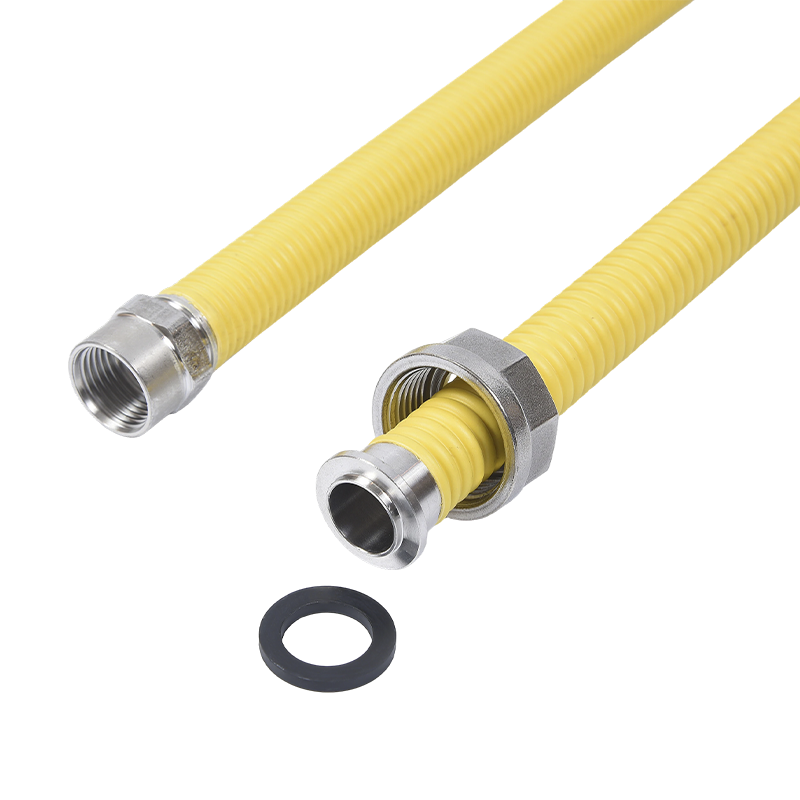
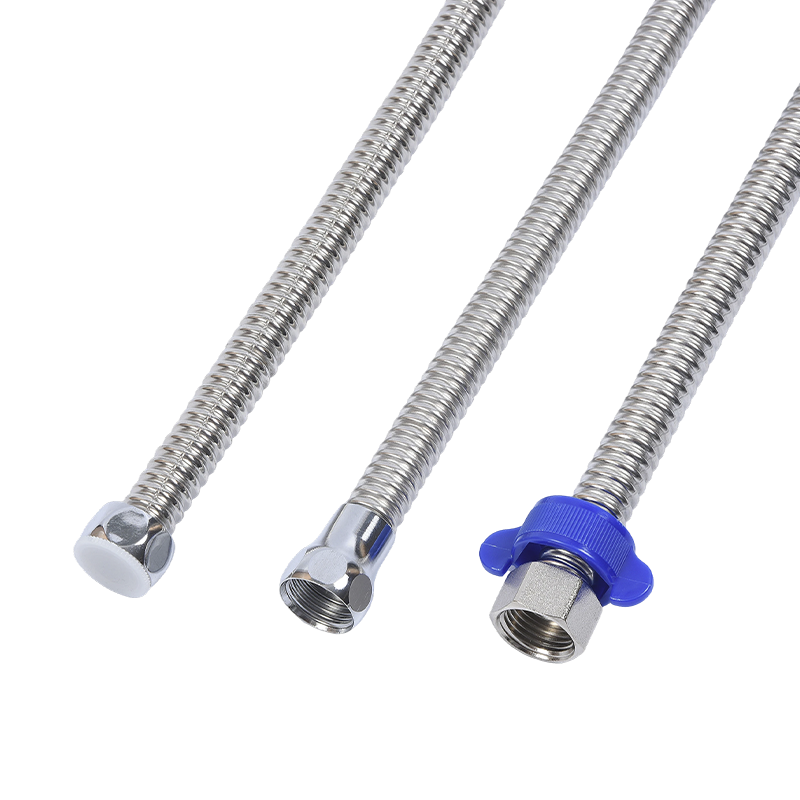
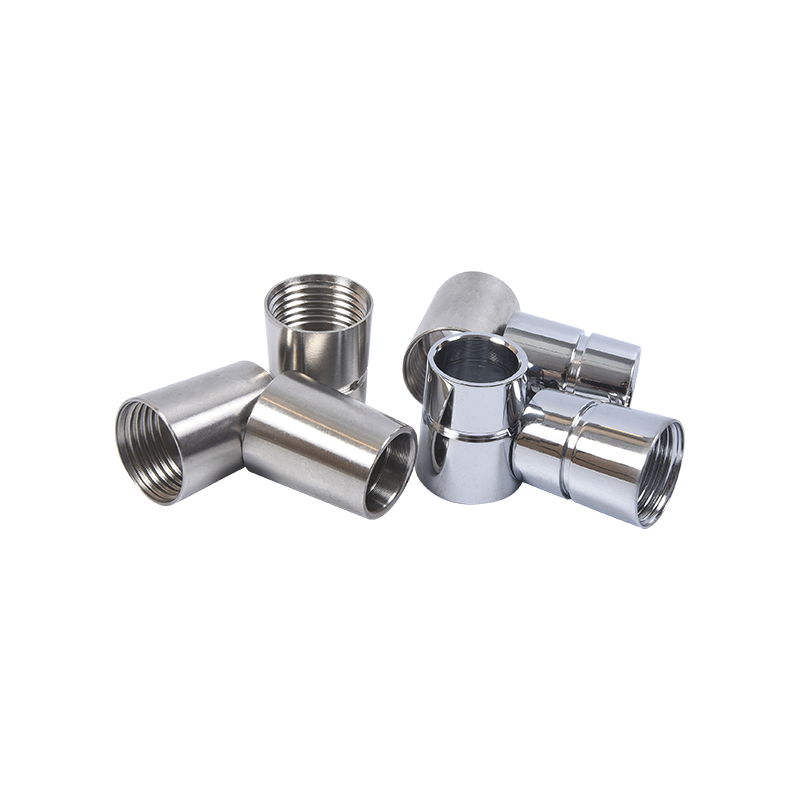
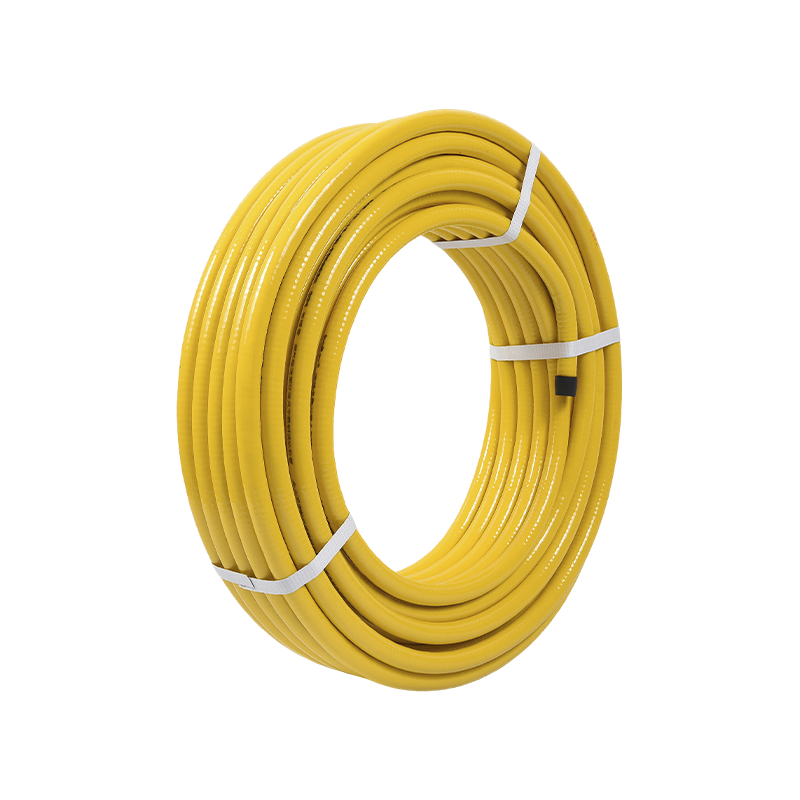
Designed with flexibility in mind, the unique corrugated structure of the tube ensures excellent ada...

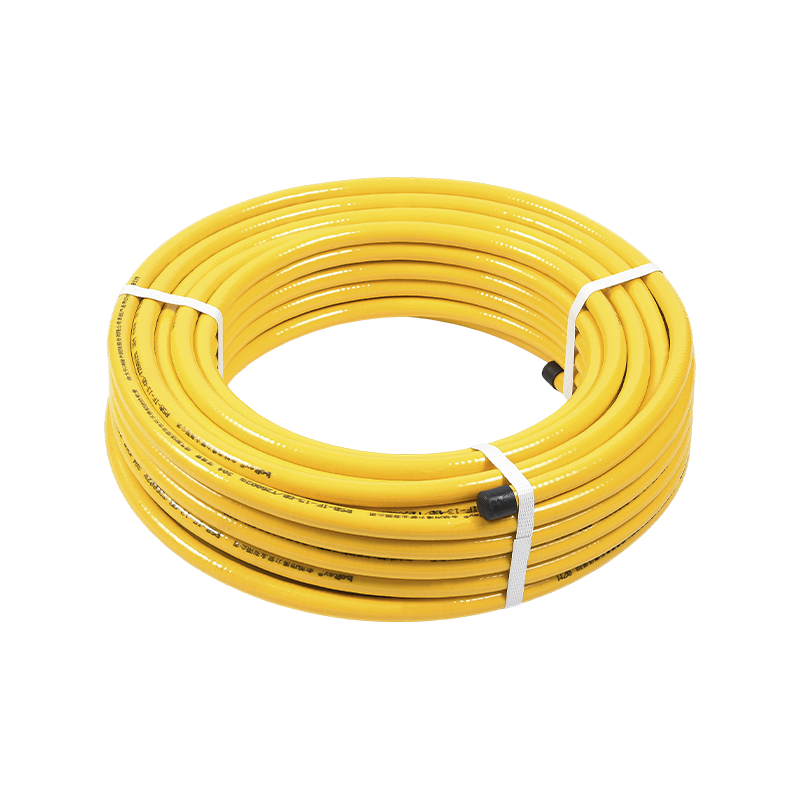
Constructed with a robust steel belt design, this hose significantly enhances the structural integri...
As China Stainless Steel Corrugated Tubes For Gas Appliances Manufacturers and Stainless Steel Corrugated Tubes For Gas Appliances Suppliers, Yuyao Boli Utilities Sometimes Company was founded in 2002 and is located in the Wu Ma Industrial Park of Yuyao City, Zhejiang Province, a relatively developed part of the industrial chain. The company specializes in producing stainless steel pipe corrugated pipe, gas pipe, heating pipe and other stainless steel pipe sanitary ware series, can also be produced according to customer requirements OEM processing, The factory covers an area of 17 acres, the company has 25 stainless steel corrugated pipe production lines, heat treatment and light reflame, cold beam manufacturing, steel belt division, laser automatic welding or marking, and ultrasonic cleaning equipment, and a complete team of strong research and development (sales). Promoting the steady development of the company's business, the company, based on the concept of "survival with quality, casting quality with heart," adheres to stable quality, reasonable prices and sound after-sales service, always provides good products and technical support to customers, continuously satisfying the needs of the vast majority of customers. The company employs more than 100 people, 5 senior engineers, has a construction area of more than 17,000 square meters, has more than 100 numerical cutting lathes, more than 20 polishing machines, several automatic welding machines, seamstresses, several automated drilling machines, five assembly lines, and so on. The product has formed a complete production management system from the bottoming--cleaning--polishing--assembly--inspection--out of the warehouse. At present, the leading series is produced, and product sales have covered many first- and second-line brands at home and abroad, and foreign trade orders have covered several countries and regions such as the Middle East and Europe. We have a good quality management system, better serve our customers, and contribute to the purification of water. Many customers are welcome to visit the company's laboratory.
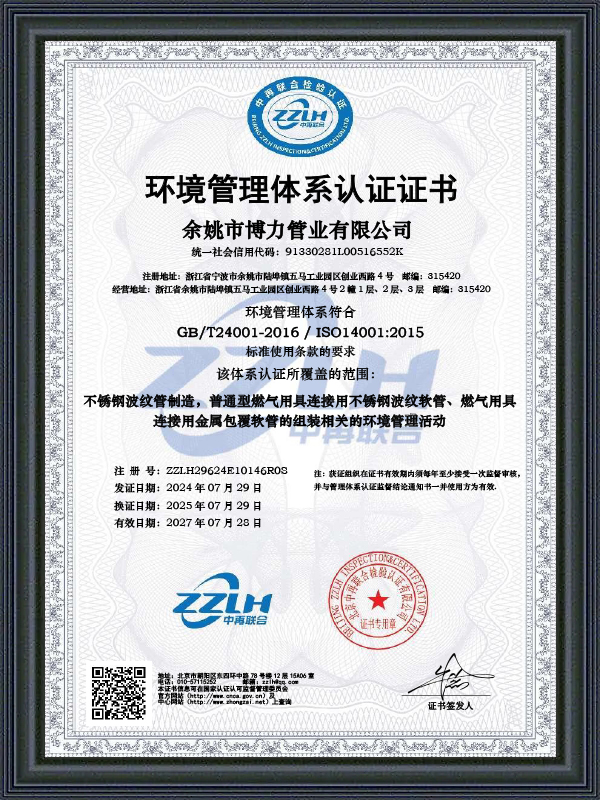
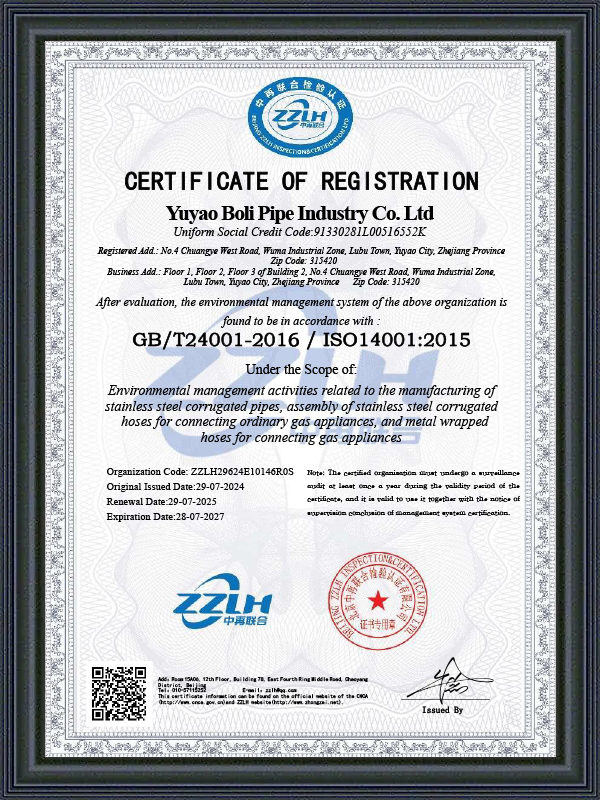
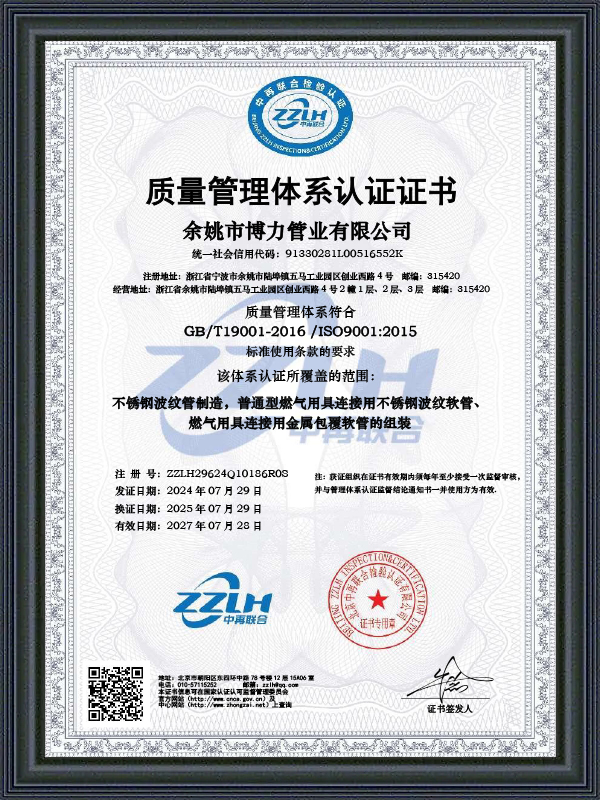
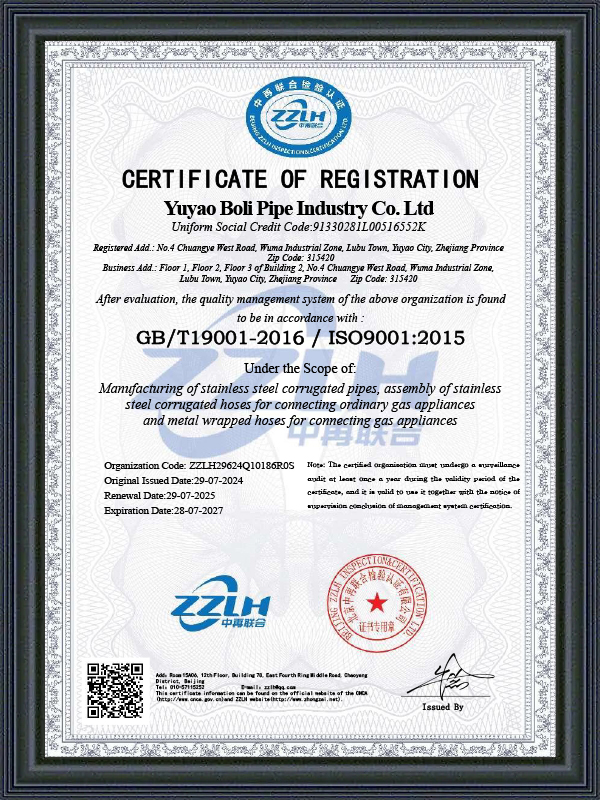
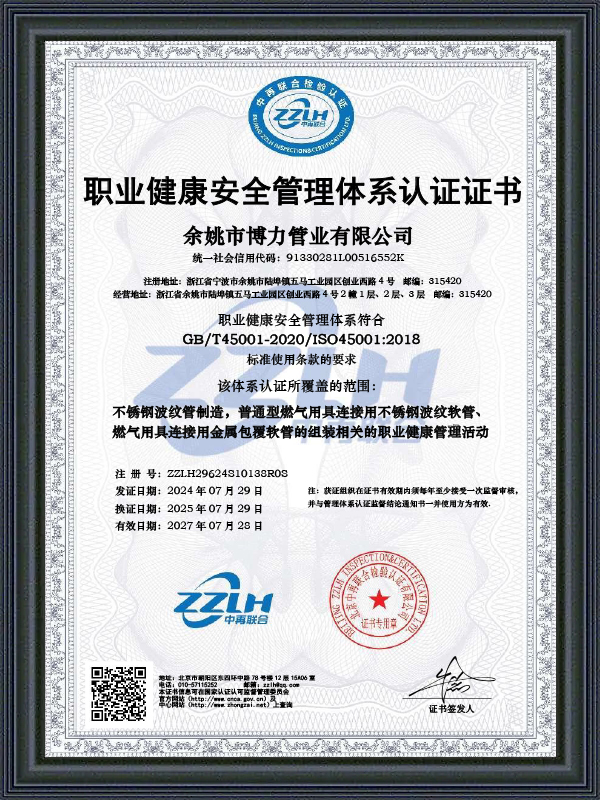
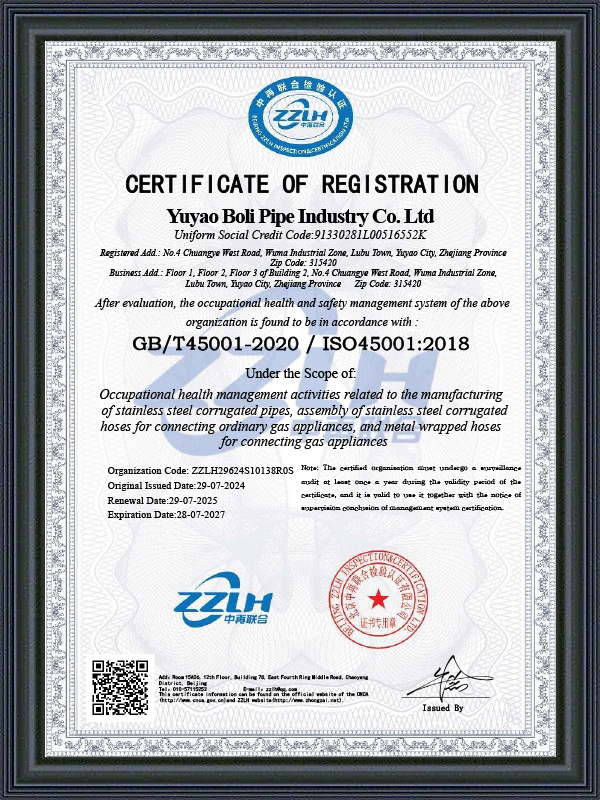
If you search for "CSST certification," you will see two very different results. One is the Certified Site Surveillance Technician credential used in asbestos and hazardous material work. The other relates to corrugated stainless steel tub...

For more than two decades, Yuyao Boli Pipe Industry has designed and manufactured stainless steel corrugated tubing for gas and plumbing applications around the world. During that time, corrugated stainless steel tubing, commonly abbreviat...
When a specification sheet for a stainless steel corrugated tube lists "1.4307" and you need to know whether that grade is a safe choice for gas or water service, the short answer is yes, provided the supplier manufactured the part to an a...
When you source stainless steel pipe for gas or water connections, corrosion resistance is not an optional property. The wrong grade or an untreated surface can turn into a leak, a blocked line, or a failed inspection within a few years. T...
Selecting the appropriate internal diameter for Stainless Steel Corrugated Tubes For Gas Appliances is a fundamental engineering requirement to ensure that residential, commercial, or industrial heating systems receive a stable and sufficient fuel supply. Unlike rigid steel pipes, flexible corrugated tubing introduces unique fluid dynamics due to its periodic internal geometry. Sizing a gas line incorrectly can lead to an inadequate volume of fuel reaching the appliance, causing burner malfunction, flame instability, and equipment shutdown. Industrial manufacturing complexes, such as Yuyao Boli Pipe Industry Ltd.—which operates 25 specialized production lines with advanced steel belt division, cold beam manufacturing, and bright annealing furnaces—rely on specific engineering calculations and empirical flow tables to assist mechanical designers in matching tube diameters with localized appliance demand.
Gas appliances are rated by their maximum energy input requirement, which is measured in British Thermal Units per hour (BTU/hr) or cubic feet per hour (CFH). To calculate the required fuel volume, engineers divide the appliance's total BTU/hr rating by the heating value of the specific fuel type, where natural gas typically yields approximately 1,000 BTU per cubic foot and propane yields roughly 2,500 BTU per cubic foot. The internal diameter of the corrugated tube determines the cross-sectional area available for gas transport. If the internal diameter is too small for a long run, the velocity of the gas increases excessively, leading to an drop in pressure before the fuel reaches the appliance control valve. Modern gas valves require a stable minimum inlet pressure to operate safely and maintain complete combustion.
The periodic wave profile of Stainless Steel Corrugated Tubes For Gas Appliances provides structural flexibility and eliminates the need for numerous elbow fittings, but it alters the fluid flow profile along the inner wall. In smooth-walled rigid pipes, fluid friction is concentrated primarily at the boundary layer. In corrugated tubes, the repeating convolutions generate localized micro-turbulence along the entire length of the run. This turbulence creates higher fluid resistance compared to a smooth pipe of the exact same nominal internal diameter. Because of this friction profile, sizing charts developed specifically for corrugated stainless steel tubing must be utilized instead of standard rigid iron pipe sizing tables. Manufacturing steps like bright annealing (light reflame) ensure that the internal corrugations maintain a uniform shape across the 25 production lines, providing a predictable and standardized friction coefficient for system calculation.
To determine the correct internal diameter, a technician must identify two primary variables: the total equivalent length of the pipe run and the allowable pressure drop of the system. The total length is measured from the gas meter or low-pressure regulator directly to the appliance inlet hookup. If the line contains mechanical fittings or manifolds, their equivalent length values must be added to the physical measurement. The allowable pressure drop is the difference between the supply pressure at the regulator and the minimum inlet pressure required by the gas appliance. For a standard low-pressure residential natural gas system supplying 7 inches of water column, a maximum pressure drop of 0.5 inches of water column is typically permitted across the flexible run to ensure consistent burner performance.
The following technical reference matrix demonstrates how varying nominal internal diameters alter the maximum BTU/hr carrying capacity of natural gas across specific lengths under a standard pressure drop of 0.5 inches of water column.
| Nominal Internal Diameter (ID) | 10 Feet (BTU/hr Capacity) | 20 Feet (BTU/hr Capacity) | 30 Feet (BTU/hr Capacity) | 40 Feet (BTU/hr Capacity) | 50 Feet (BTU/hr Capacity) |
| 3/8 inch (DN10) | 42,000 | 29,000 | 23,000 | 20,000 | 18,000 |
| 1/2 inch (DN15) | 81,000 | 57,000 | 46,000 | 40,000 | 35,000 |
| 3/4 inch (DN20) | 166,000 | 116,000 | 94,000 | 81,000 | 72,000 |
| 1 inch (DN25) | 324,000 | 227,000 | 184,000 | 159,000 | 142,000 |
High-demand appliances, such as tankless water heaters, commercial ranges, or outdoor patio heating matrixes, frequently require initial startup volumes that far exceed their baseline operating parameters. When sizing the internal diameter for these specific installations, engineers utilize a branch length method. This process involves calculating the longest single run from the gas source to any appliance in the system, and sizing every branch line based on that total length capacity. Utilizing automated laser marking equipment, manufacturers print precise measurement indicators and internal diameter specifications directly on the outer jacket of the tubing, allowing installers to quickly cross-reference field runs with engineering flow charts to prevent under-sizing mistakes during multi-appliance deployment.
Once the correct internal diameter has been determined and the tubing segment is cut, the structural cleanliness of the inner channel must be maintained to prevent flow restriction. Corrugated gas tubes pass through extensive ultrasonic cleaning systems at the production plant to completely eliminate chemical lubricants, metal slivers, or scaling residues within the convolutions. Any remaining particulate matter can disrupt the laminar core of the gas flow, artificially increasing the turbulence factor and causing a greater pressure drop than the engineering sizing tables indicate. Keeping the internal channel clean ensures that the physical dimensions of the selected diameter deliver the exact BTU/hr capacities calculated during the design phase.
Q: How do your 25 production lines maintain structural uniformity across different batches of Stainless Steel Corrugated Tubes For Gas Appliances?
A: The scale of operating 25 distinct production lines allows for dedicated machinery setups assigned to specific tube dimensions. This continuous setup minimizes the mechanical wear and calibration drift associated with frequent line changeovers, ensuring that the corrugation profiles and wall thicknesses remain uniform across all manufacturing batches.
Q: What specific benefit does the bright annealing heat treatment provide when connecting these tubes to high-vibration gas appliances?
A: Appliances like commercial gas dryers or industrial boilers generate constant mechanical vibrations. The bright annealing, or light reflame process, treats the stainless steel after corrugation to eliminate internal mechanical stress, giving the tubes the necessary structural flexibility to dampen these continuous micro-vibrations without suffering from fatigue cracking or joint loosening.
Q: How does the on-site steel belt division equipment support custom technical requests for specialized gas appliance connectors?
A: Having an in-house steel belt division allows the production team to slice raw stainless steel coils to precise width tolerances tailored to custom OEM specifications. This precise edge preparation feeds directly into the cold beam manufacturing lines, resulting in flawless longitudinal laser automatic welding that can withstand rigorous pressure thresholds.
Q: Why is ultrasonic cleaning essential for corrugated tubes used specifically in residential gas cooking appliances?
A: Residential cooking environments demand high standards of safety and cleanliness. The multi-stage ultrasonic cleaning equipment utilizes acoustic cavitation waves to completely strip away industrial pressing oils, grease residues, and fine metallic dust from deep within the internal wave convolutions, ensuring a contaminant-free interior before the tube is coupled to an appliance valve.
Q: In what way does the laser automatic marking system enhance regulatory compliance for international gas appliance distributors?
A: Gas safety codes require indelible product tracking data to be visible at all times. The inline laser automatic marking machinery etches essential data such as batch codes, diameter ratings, and safety certifications directly into the metal surface, creating permanent identifiers that remain readable despite exposure to the heat, moisture, and cleaning solvents common around gas appliances.
Q: How does your complete research and development team handle flow capacity challenges for high-BTU gas appliance installations?
A: The integrated research and development team analyzes the hydraulic friction factors introduced by the internal corrugations. By correlating internal diameter parameters with appliance energy requirements, they guide the engineering of custom convolution heights and spacing to balance structural flexibility with the specific BTU/hr flow rates required by heavy-duty appliances.

Copyright © Yuyao Boli Pipe Industry Ltd. All Rights Reserved

Custom Stainless Steel Corrugated Tubes For Gas Appliances Manufacturers