Industry News
Content
Stainless steel gas piping — most commonly known as CSST (Corrugated Stainless Steel Tubing) — must be installed in accordance with the National Fuel Gas Code (NFPA 54) and local jurisdiction amendments, and it requires direct bonding with a minimum 6 AWG copper bonding wire to reduce lightning-strike damage risk. Installation costs typically range from $15 to $25 per linear foot installed, or $500–$2,000 for a typical whole-home gas line installation, depending on run length and number of appliances served. Because gas line work involves explosion and carbon monoxide risk, licensed professional installation is required in nearly every U.S. jurisdiction — this is not a standard DIY project, even though CSST itself is easier to route than rigid black iron pipe.
Below, we break down the relevant codes, real-world cost ranges, and the installation practices that separate a safe, code-compliant job from a liability risk.
When people search for "stainless steel gas pipe," they're almost always referring to CSST — a flexible, corrugated stainless steel tubing developed in the 1980s as an alternative to rigid black iron pipe for natural gas and propane distribution. Unlike black iron, which requires threading, cutting, and multiple fittings at every turn, CSST can be bent by hand around obstacles, dramatically reducing the number of joints — and therefore potential leak points — in a typical installation.
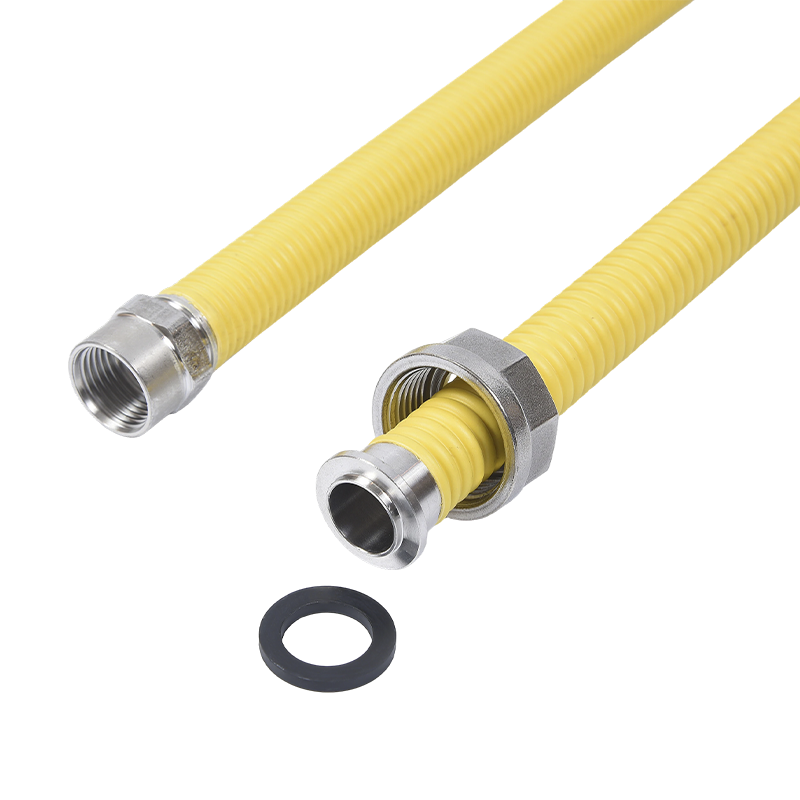
CSST is manufactured under the ANSI LC-1 / CSA 6.26 standard and is typically sold with a yellow, black, or PVC-coated exterior jacket for protection and identification. It's now used in an estimated 60% of new U.S. homes with gas service, largely due to faster installation times compared to traditional rigid piping.
Gas piping installation is one of the most heavily regulated areas of residential construction. The table below summarizes the core code references that govern stainless steel gas pipe installation in the U.S.
| Code / Standard | Governs | Key Requirement |
|---|---|---|
| NFPA 54 / IFGC | Fuel gas piping systems | Sizing, materials, support spacing, and clearance rules |
| ANSI LC-1 / CSA 6.26 | CSST product manufacturing | Pressure rating, corrugation strength, and jacket material |
| NEC Article 250 | Electrical bonding | Minimum 6 AWG copper bonding conductor to the gas piping system |
| Local AHJ Amendments | Jurisdiction-specific rules | May restrict CSST use, require additional shielding, or mandate specific brands |
Always confirm requirements with your local Authority Having Jurisdiction (AHJ) before starting work — bonding requirements, allowable routing locations, and even approved CSST brands can vary significantly by city and county.
Installation costs depend heavily on run length, number of appliances, and whether the job involves new construction or a retrofit into an existing wall or floor cavity.
CSST generally costs 20–30% less to install than equivalent black iron pipe runs, mainly due to reduced labor time — fewer joints mean faster installation and lower risk of callback repairs for leaks.
Whether you're hiring a contractor or simply want to understand what a quality installation looks like, these practices separate a code-compliant job from a future liability.
Following a series of lightning-related CSST failures in the early 2000s, manufacturers and code bodies now require direct bonding of the CSST system to the home's electrical grounding system using a minimum 6 AWG copper conductor. Proper bonding significantly reduces the risk of arcing damage during a nearby lightning strike — this single step is the most commonly missed item during inspections.
CSST must be kept clear of sharp framing edges, nails, and screws. Code requires steel striker plates at any point where the tubing passes within 1.5 inches of a framing member's edge, protecting against accidental puncture from drywall installation or future renovations.
CSST brands are not universally interchangeable — fittings, connectors, and tools are typically brand-specific. Mixing components across manufacturers can void warranties and, in some cases, fail inspection outright.
A standard installation requires a pressure test (commonly using air or inert gas) held for a minimum duration specified by local code — often 10–15 minutes — before any wall, ceiling, or floor cavity is closed up. This step catches slow leaks that wouldn't be apparent during a quick visual inspection.
| Factor | CSST (Stainless Steel) | Black Iron Pipe |
|---|---|---|
| Installation speed | Fast (flexible, fewer fittings) | Slower (requires threading and cutting) |
| Number of joints | Fewer (can route around obstacles) | More (joint needed at every turn) |
| Bonding required | Yes, mandatory | Not required (rigid metal pipe is self-grounding) |
| Cost | Generally lower installed cost | Generally higher due to labor time |
| Lifespan | 25+ years with proper bonding | 40+ years, very durable |
Most CSST-related incidents and failed inspections trace back to a handful of recurring errors:
Stainless steel gas pipe requires minimal routine maintenance once properly installed and inspected, but a few checks help catch problems early:
Stainless steel gas pipe (CSST) offers faster installation, lower labor costs, and fewer leak-prone joints compared to traditional black iron piping, making it the preferred choice in most new residential construction today. That said, proper bonding, striker plate protection, and a documented pressure test are not optional extras — they're the difference between a system that performs safely for decades and one that fails inspection or, worse, becomes a safety hazard. Always hire a licensed, code-certified professional for any gas line installation or modification.
Constructed with a spiral corrugation design, this tube boasts remarkable resistance to corrosion, pressure, and mechanical forces. The intricate spiral structure not only adds strength but also ensur...
See Details
The stainless steel bathroom basin water heater pipe is a critical component designed to efficiently and safely deliver hot water to bathroom basins. It's primarily used in residential and commercial ...
See Details
The primary function of a stainless steel female thread straight connector is to connect two externally threaded components or fittings, enabling efficient fluid transfer within a piping system. It fe...
See DetailsStainless steel gas pipes are the preferred choice for transporting natural gas, propane, and other...
READ MOREWhich Stainless Steel Gas Pipe Should You Choose? For the majority of residential and light commerc...
READ MOREQuick Answer: Choosing the Right Stainless Steel Gas Pipe Stainless steel gas pipes are corrosion-r...
READ MOREWhat Makes a Stainless Steel Faucet a Good Choice? A stainless steel faucet, particularly one made ...
READ MORECopyright © Yuyao Boli Pipe Industry Ltd. All Rights Reserved