

 English
 русский
 عربى
Industry News
Home / News / Industry News / Austenitic Stainless Steel Grades, Applications, and Buying Considerations


Content
A procurement engineer for a residential project was asked to approve a gas hose labeled simply "stainless steel." The supplier quoted a good price and promised a corrugated tube. But when the material certificate arrived, it showed no grade reference, no chromium or nickel content, and no material test report. That is how a small decision about an austenitic grade becomes a safety problem. For a gas connection, the difference between 304 and 316L is not a premium detail; it is a risk boundary.
Austenitic stainless steel is one of the five families of stainless steel, alongside ferritic, martensitic, duplex, and precipitation-hardening types. Its defining feature is the face-centered cubic (FCC) crystal structure, which is retained from room temperature up to the melting point. This structure is achieved by adding nickel or nitrogen to the alloy.
Practical consequences matter if you are buying pipe. The FCC structure gives the metal outstanding ductility, which is why corrugated tubes, bellows, and flexible hoses are made from austenitic grades. The material also stays tough at low temperatures, resists embrittlement, and does not harden when heated. This makes it the preferred choice for hot water lines, gas appliance connectors, and any application where a welded joint must remain stable.
Most austenitic grades belong to the AISI 200 and 300 series. The 300 series is the dominant group in sanitary and industrial piping. Around 70% of the stainless steel machined worldwide belongs to the austenitic family. Within that family, 304 and 316 account for the largest share of demand. The 316L variant, with its lower carbon content, is used when the welding environment could otherwise cause chromium carbide precipitation.
The grade number on a fitting or a hose reveals more than brand identity. It is a chemical specification that controls corrosion behavior. 304, or 18/8, contains about 18% chromium and 8% nickel. It is the default grade for indoor water pipes and appliance connections. 316 adds molybdenum, usually around 2%, which improves resistance to pitting and crevice corrosion in chloride-rich environments. 316L further reduces the carbon content to 0.03% or lower, which protects the grain structure after welding.
| Grade | Main Alloying Elements | Key Characteristic | Typical Use |
|---|---|---|---|
| 304 | 18% Cr, 8% Ni | General-purpose corrosion resistance | Indoor water pipes, kitchen appliances |
| 316 | 16% Cr, 10% Ni, 2% Mo | Better resistance to chlorides and chemical agents | Coastal projects, marine exposure |
| 316L | 16% Cr, 10% Ni, 2% Mo, max 0.03% C | Low carbon, suitable for welding without sensitization | Gas connection hoses, welded assemblies, buried lines |
For a cold and hot water plumbing connection, 304 normally delivers enough corrosion resistance at a reasonable cost. If the piping runs in a coastal area, near a swimming pool, or in an industrial zone with airborne chlorides, 316 becomes a better choice. For a gas appliance connector, the welded joint matters. 316L is widely preferred because the lower carbon content reduces the chance of grain boundary attack. This is also why gas appliance codes often point to 316L or a stabilized 316 grade.
The reason is not simply that austenitic stainless steel is a "premium" material. It has the right combination of properties for flexible, leak-resistant, and long-lived pipe systems.
The FCC structure allows the steel to absorb bending and vibration without cracking. A gas stove connection hose must survive repeated movement during cleaning and maintenance. A corrugated water heater pipe must handle expansion and contraction without fatigue. Austenitic grades are designed for that.
The material also forms a self-healing oxide layer on its surface. When the pipe is scratched, the chromium in the steel reacts with oxygen to restore this passive layer. This is a huge advantage for buried gas lines, where a small surface defect could otherwise become the starting point for corrosion.
 316L Corrugated Flexible Natural Gas Hose for Kitchen AppliancesThis 316L stainless steel hose resists corrosion and flexes easily, making it a safe choice for kitchen gas connections where repeated bending and high temperatures occur.View Product →
A 316L corrugated flexible natural gas hose illustrates the combination of corrosion resistance and flexibility. It is commonly used for connection to kitchen gas appliances, where the hose must form a tight bend without kinking. The low carbon content gives the welded bells and the fitting joints a stable structure.
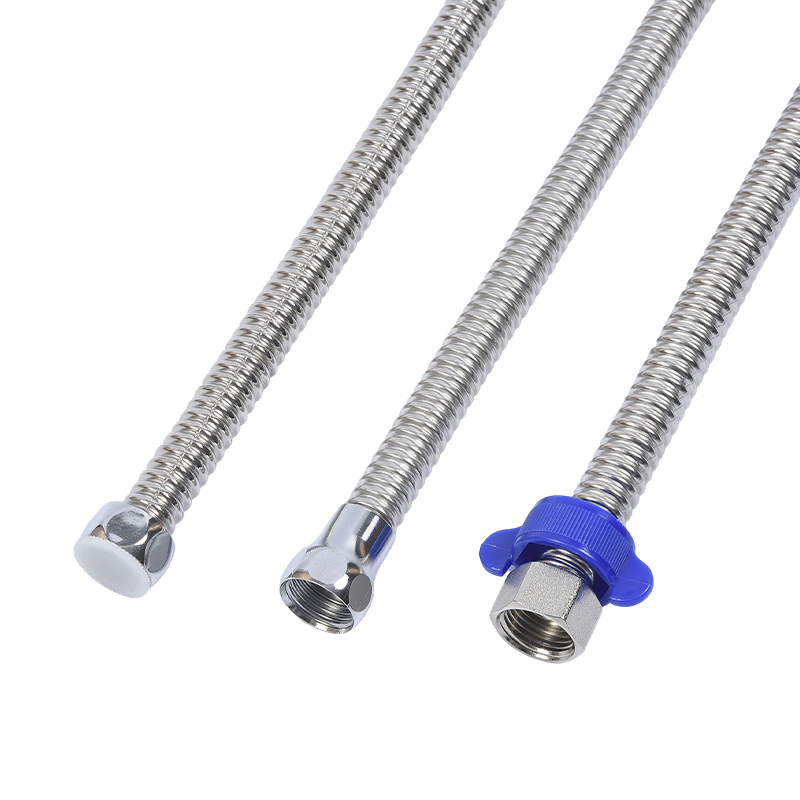
For water supply lines, a 304 grade is the range selected for a standard cold and hot explosionproof corrugated pipe. It handles the repeated pressure changes and the variable water temperatures found in residential systems.
304 Stainless Steel Universal Cold and Hot Explosion-Proof Corrugated PipeDesigned for residential water systems, this 304 corrugated pipe withstands temperature variations and pressure surges, offering flexibility and durability for hot and cold supply lines.View Product →
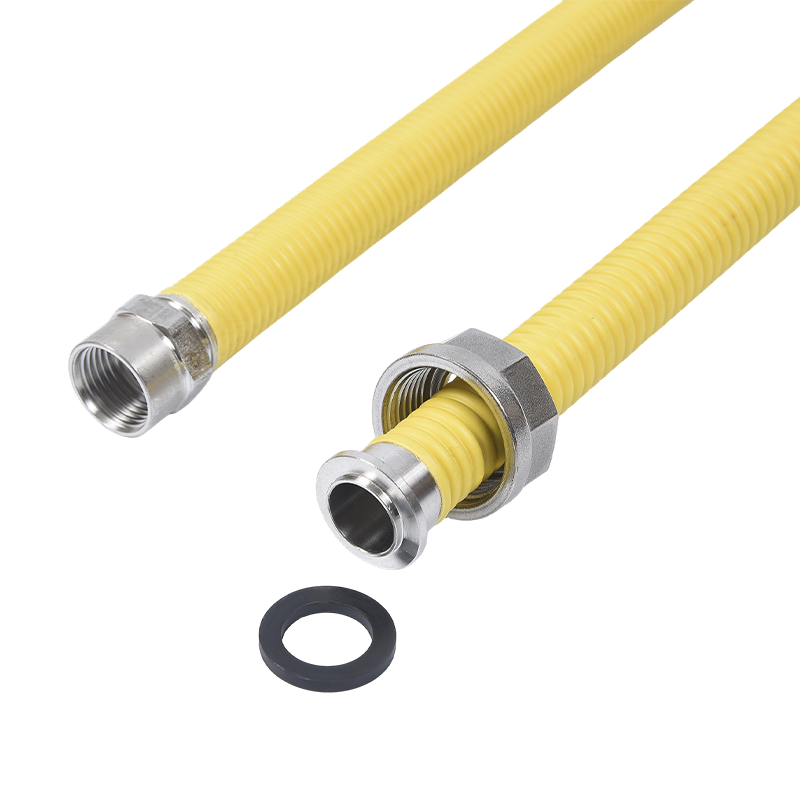
At the gas stove connection point, a flexible corrugated tube is often the most practical design. The 304 stainless steel gas stove connecting tube combines an easy bend with the strength needed to hold gas pressure. This is the part where the supplier must pay attention to the wall thickness and the end fittings, because the thread, nut, and ferrule must all be made from compatible material.
304 Stainless Steel Gas Stove Connecting Tube with PVC CoatingThis flexible connecting tube features a protective PVC layer and flat washer for secure, leak-resistant gas stove hookups, balancing strength and ease of installation.View Product →Start from the conclusion. For a residential gas line, if you cannot guarantee welding quality or if the contractor is unknown, specify 316L. For a typical indoor water supply line, 304 is sufficient and more economical. In a coastal building, both gas and water lines should be upgraded to 316 or 316L.
Beyond the grade, a procurement order must reference a recognized standard. In China, GB/T 14976 and GB/T 12771 cover stainless steel seamless and welded pipes respectively. International specifiers often use ASTM A312, EN 10217-7, or JIS G3459. State the standard and the grade together, because a grade number alone does not define wall thickness or testing requirements.
Useful procurement checks include the following.
Maintenance planning is another factor. Austenitic stainless steel bellows and hoses are typically maintenance-free, but the connection point still needs annual inspection for leaks around the thread. A leak at a loosened nut is a function of installation quality, not of the steel grade.
When the grade is part of the safety chain, process control becomes an issue of design. The steel coil for a gas hose may contain trace amounts of sulfur, manganese, or nitrogen that affect weldability. A reliable batch of 304 or 316L must have a consistent composition and clean surface. This is why the supplier's equipment list is relevant. Strip slitting, cleaning, annealing, welding, and pressure testing are not decorative steps. They determine whether a corrugated tube will hold around a weld seam.
In manufacturing practice, the number of production lines also suggests the capacity to keep batch traceability. Yuyao Boli Pipe Industry operates 25 stainless steel corrugated pipe production lines, more than 100 CNC lathes, over 20 polishing machines, several automatic welding units, and five assembly lines. This equipment base supports custom lengths, special end types, and OEM processing. The production flow covers slitting, cleaning, polishing, assembly, inspection, and warehousing.
The ability to deliver gas appliance hoses and water supply bellows from the same factory reduces the risk of mixed materials and simplifies quality management. You can order a complete set of stainless steel gas pipes with matching nuts and connectors from one source, and keep the chemical composition aligned across the assembly.
For a deeper understanding of how corrugated stainless steel tubing performs under real gas service conditions, see an analysis of CSST safety.
Austenitic stainless steel is not a single product. It is a family of materials with different levels of nickel, chromium, and molybdenum. For a gas appliance connection or a water supply bellows, the starting point is always the operating environment. Once the environment is clear, the grade becomes a short decision among 304, 316, and 316L. The final protection for a buyer is not just a grade name on a label, but a traceable material certificate and a supplier that can hold that specification in production.

Constructed with a spiral corrugation design, this tube boasts remarkable resistance to corrosion, pressure, and mechanical forces. The intricate spiral structure not only adds strength but also ensur...
See Details
The stainless steel bathroom basin water heater pipe is a critical component designed to efficiently and safely deliver hot water to bathroom basins. It's primarily used in residential and commercial ...
See Details
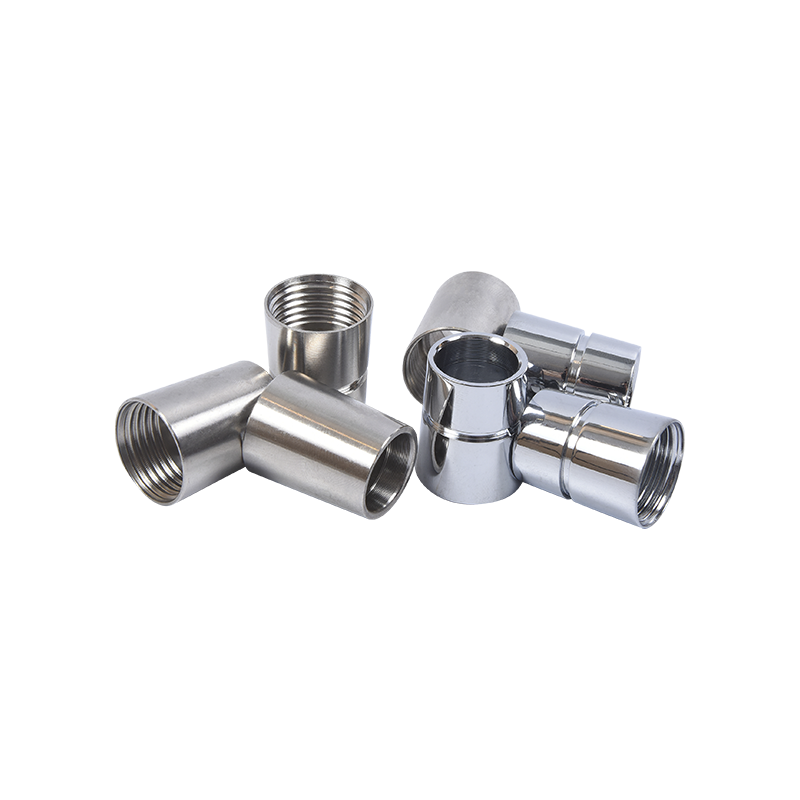
The primary function of a stainless steel female thread straight connector is to connect two externally threaded components or fittings, enabling efficient fluid transfer within a piping system. It fe...
See DetailsWhat Makes a Stainless Steel Faucet a Good Choice? A stainless steel faucet, particularly one made ...
READ MOREWhich Stainless Steel Gas Pipe Should You Choose? For the majority of residential and light commerc...
READ MOREQuick Answer: What Determines the Quality of a Stainless Steel Faucet The quality and longevity of ...
READ MOREFor more than two decades, Yuyao Boli Pipe Industry has designed and manufactured stainless steel c...
READ MORE
Copyright © Yuyao Boli Pipe Industry Ltd. All Rights Reserved

 ++86-15867355556