

 English
 русский
 عربى
Industry News
Home / News / Industry News / 1.4307 Stainless Steel Explained: Properties, Corrosion Resistance, and Uses


Content
When a specification sheet for a stainless steel corrugated tube lists "1.4307" and you need to know whether that grade is a safe choice for gas or water service, the short answer is yes, provided the supplier manufactured the part to an appropriate standard and can prove the heat treatment. EN 1.4307, also known as X2CrNi18-9 or AISI 304L, is the low-carbon version of the most widely used stainless steel family in the world. Its lower carbon ceiling changes the material's behavior in welded and cold-formed products such as bellows, flexible gas connectors, and plumbing hoses, which is why anyone buying flexible stainless steel components should understand this grade before approving an order.
1.4307 is an austenitic stainless steel defined in the European EN 10088 series. The short designation X2CrNi18-9 decodes as follows: X marks a high-alloy steel, the digit 2 indicates the low carbon level (0.03% maximum), and the figures 18 and 9 refer to the approximate percentages of chromium and nickel respectively. The austenitic microstructure, the same face-centered cubic structure found in 304, gives the material high ductility, excellent toughness, and non-magnetic behavior in the annealed condition.
| Element | 1.4307 (X2CrNi18-9) |
|---|---|
| Carbon (C) | 0.030% max. |
| Silicon (Si) | 1.00% max. |
| Manganese (Mn) | 2.00% max. |
| Phosphorus (P) | 0.045% max. |
| Sulfur (S) | 0.030% max. |
| Chromium (Cr) | 17.50 to 19.50% |
| Nickel (Ni) | 8.00 to 10.50% |
| Nitrogen (N) | 0.11% max. |
The most important figure in this list is the 0.030% carbon ceiling. Standard 304 (1.4301) may contain up to 0.07% carbon; the reduction in 1.4307 is what protects the material around weld joints, as explained below.
Austenitic stainless steel does not respond to heat treatment for hardening; its strength comes from solid-solution strengthening and from cold work. In the solution-annealed condition, denoted +AT, EN 1.4307 presents the following typical minimum values for flat products.
| Property | Value |
|---|---|
| Tensile strength Rm | 500 to 700 MPa |
| 0.2% proof strength Rp0.2 | 200 MPa min. |
| 1.0% proof strength Rp1.0 | 250 MPa min. |
| Elongation A80 | 45% min. |
| Brinell hardness | 215 HBW max. |
For producers of corrugated metal hose, the two decisive numbers are Rp0.2 and elongation. The proof strength of 200 MPa tells you that a formed bellows will resist internal pressure without permanent deformation, while the elongation of at least 45% is what allows a flat strip to be drawn into deep corrugations and folds without cracking during manufacturing.
The corrosion resistance of the 18/8 stainless family relies on a thin, self-healing chromium oxide layer on the surface. That layer resists atmospheric attack, clean fresh water, natural gas condensate, and most food or mild chemical media. What separates 1.4307 from ordinary 304 is what happens next to that layer after welding. When austenitic stainless steel containing more than about 0.05% carbon is exposed to temperatures between 450 and 850 °C, which is exactly what happens in the heat-affected zone beside a weld, chromium carbide precipitates at the grain boundaries. Chromium is drawn away from the adjacent matrix, creating a locally chromium-depleted area. In aggressive media, these areas corrode first. The condition is called sensitization, and it is the classic weakness of welds in standard 304.
1.4307 keeps carbon at or below 0.03%, leaving little material for chromium carbides to form. As a result, a longitudinally welded 1.4307 tube retains its corrosion resistance in the as-welded condition, with no post-weld solution annealing. For thin-wall products such as gas liners and water hoses, this means the longitudinal seam, the most stressed and most exposed zone, is not a preferential corrosion site.
In the workshop, 1.4307 behaves predictably. It can be welded by TIG, MIG/MAG, laser, plasma, and resistance welding, and no preheat is required. Because of the low carbon content, post-weld annealing is usually unnecessary. The material work-hardens more noticeably than carbon steel, and that characteristic is managed in production by rolling schedules and intermediate softening when very deep draws are involved. A properly performed bright annealing step after corrugation restores the fully austenitic, highly ductile microstructure, so the finished bellows bends and flexes without fatigue cracks forming at the roots of the corrugations.
These three grades answer a large share of the questions we receive from customers sourcing gas and water connection components. The table below summarizes the practical differences.
| Criterion | 1.4307 (304L) | 1.4301 (304) | 1.4404 (316L) |
|---|---|---|---|
| Maximum carbon | 0.03% max. | 0.07% max. | 0.03% max. |
| Molybdenum | None | None | 2.0 to 2.5% |
| Resistance to chlorides | Moderate | Moderate | Higher |
| As-welded corrosion | Excellent | Can be reduced | Excellent |
| Relative material cost | Middle | Lower | Higher |
| Typical applications | Welded tubes, gas, water | General sheet and bar | Marine, aggressive media |
The rule of thumb: choose 1.4307 whenever the component is welded and will carry water, gas, or food products. Choose 1.4301 only for unwelded or fully annealed parts under strong cost pressure. Step up to 1.4404 when chlorides, acidity, or elevated temperatures go beyond the comfort zone of fresh water and natural gas.
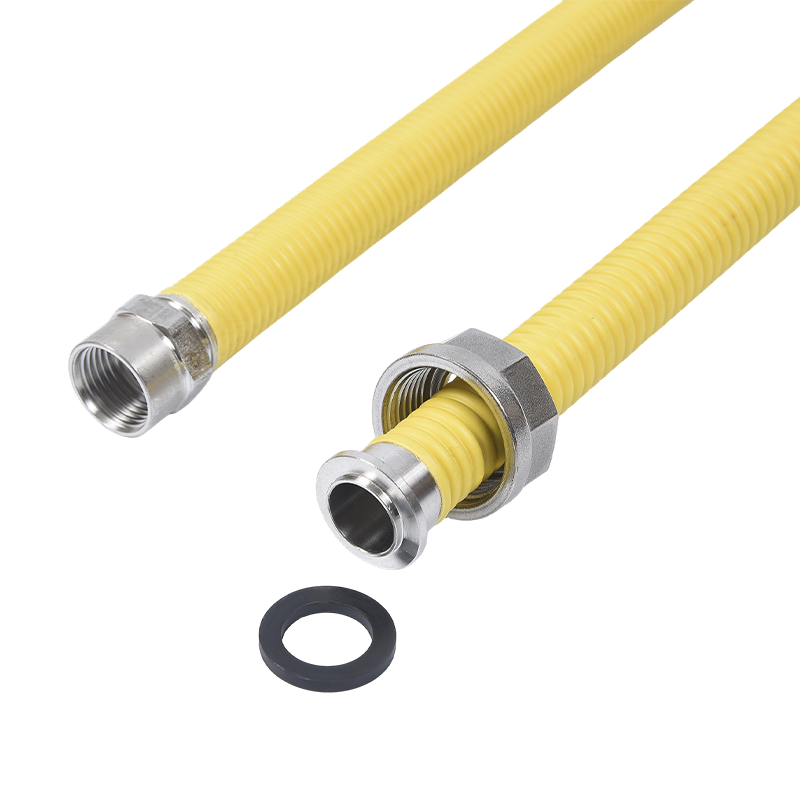
A gas connector must hold working pressures ranging from a few kilopascals up to the limits set by the applicable gas code, resist vibration from burners, and be flexible enough to install in tight cabinets without kinking. A 1.4307 corrugated tube in the solution-annealed condition handles those conditions comfortably. The low-carbon seam stays sound over years of service, and an optional PVC or epoxy protective layer adds a second line of defense against external damage. This is the material basis for our AISI 304/304L corrugated gas tubes before assembly of brass or stainless fittings and a 100% leak test. For wall-embedded runs, the same logic extends to a dedicated buried-wall gas tube design where corrosion resistance is the governing safety factor.
 304 Stainless Steel Corrugated Buried Wall Gas Tube with PVC CoatingDesigned for wall-embedded gas runs, this 304 stainless steel corrugated tube features a bright yellow PVC coating that protects against corrosion and UV damage, ensuring durable performance in challenging conditions.View Product →
We also examine in our industry notes why corrugated stainless steel tubing is regarded as one of the safest choices for modern gas installations.
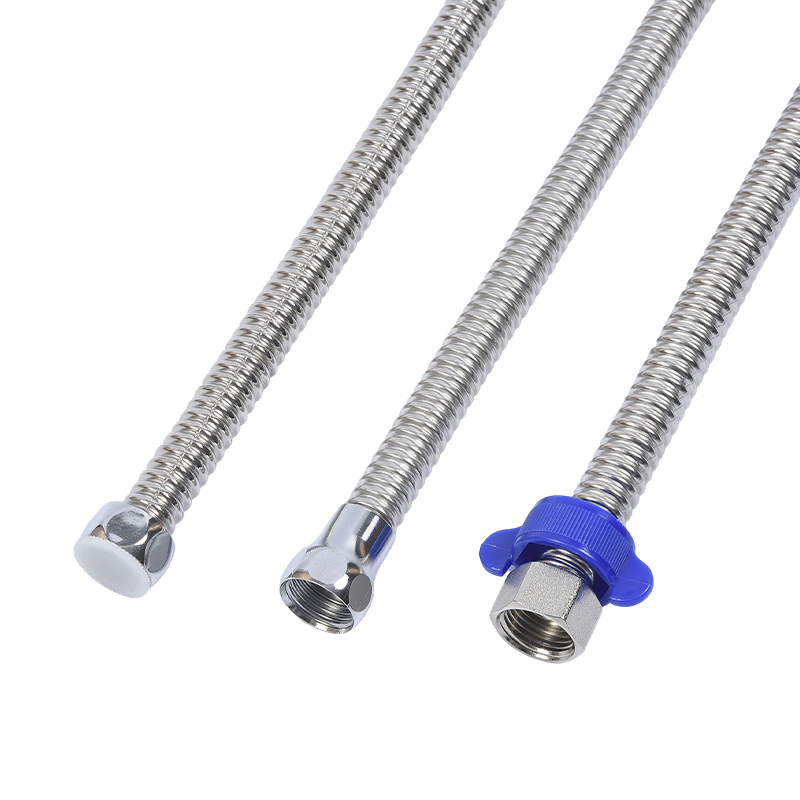
Plumbing loops put 1.4307 in its most familiar territory. Clean tap water, occasional chlorine treatment, and temperature cycles up to roughly 90 °C stay well within the material's capabilities. The smooth stainless surface resists scaling and biofilm buildup, eliminating the rust streaks that plain steel or poorly electroplated parts leave behind. In our range of universal cold-and-hot water connectors, basin hoses, and water heater lines, 1.4307-based bellows pass pressure-cycle and leak tests repeated hundreds of thousands of times before a single unit leaves the factory. The grade's elongation and spring-back are what keep the corrugations flexible for years rather than lapsing into hard, brittle creases.
304 Stainless Steel Universal Cold and Hot Water Corrugated PipeFlexible 304 stainless steel bellows for residential cold and hot water systems, absorbing thermal expansion and pressure surges while resisting scaling and biofilm for reliable long-term service.View Product →A corrugated tube is only as reliable as its end connections. Stainless steel hexagonal nuts, internal-thread nuts, straight connectors, and crimping sleeves provide the grip that holds the bellows against pull-out and pressure. When these fittings are made from the same austenitic family as the tube, there is no galvanic mismatch between dissimilar metals and no difference in thermal expansion to loosen the joint. In our assembly shop, 1.4307-compatible fittings offer another advantage: threads cut cleanly without galling, and the crimping sleeve deforms evenly around the corrugated profile, producing a visible, verifiable crimp that survives vibration and thermal cycling.
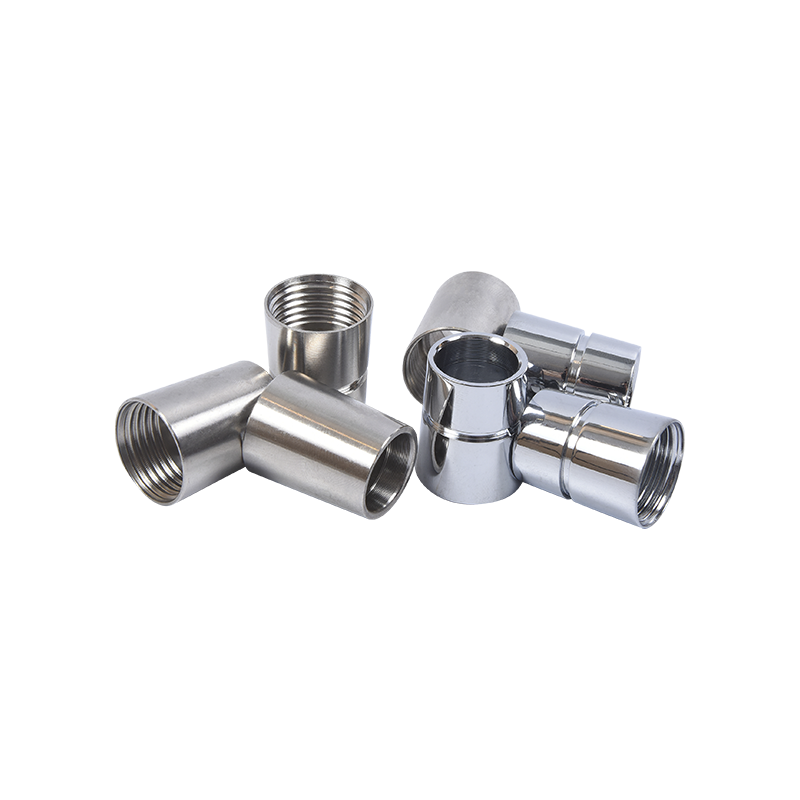
Stainless Steel Gas Pipe Crimping Sleeve for Secure ConnectionsThis crimping sleeve forms a leak-proof joint by deforming evenly around the corrugated profile, matching the tube's austenitic steel to prevent galvanic mismatch and withstand vibration.View Product →EN 1.4307 is defined in the EN 10088 series and has equivalents in every major industrial standard system. You are most likely to see it written as AISI 304L or UNS S30403 in North American documentation, SUS 304L in Japan, and 022Cr19Ni10 in the Chinese GB/T system. Irrespective of the name, the core specification is the same.
Components made from 1.4307 are normally supplied in the solution-annealed condition (+AT). This final heat treatment dissolves any carbides formed during processing and restores the austenitic microstructure to its softest, most ductile state. When you buy stainless steel hoses or fittings from any supplier, ask for the mill test certificate. It lists the heat number, chemical composition, mechanical properties, and the heat treatment performed. That piece of paper is what separates a verifiable engineering material from a label printed on a box. You can explore the full range of corrugated gas tubes, plumbing connectors, and stainless steel fittings on our product catalog pages.
To sum up, 1.4307 is the low-carbon member of the most popular stainless steel family on earth, and that single difference makes it the right baseline grade for welded, cold-formed, corrosion-exposed components. Gas connectors, water heater hoses, shower pipes, and the fittings that tie them together all benefit from its balanced corrosion resistance, high elongation, reliable weldability, and moderate cost. Specify 1.4307 with the correct delivery condition, confirm it with a mill certificate, and the flexible stainless steel components you source will hold their performance over decades of residential and light commercial service.

Constructed with a spiral corrugation design, this tube boasts remarkable resistance to corrosion, pressure, and mechanical forces. The intricate spiral structure not only adds strength but also ensur...
See Details
The stainless steel bathroom basin water heater pipe is a critical component designed to efficiently and safely deliver hot water to bathroom basins. It's primarily used in residential and commercial ...
See Details
The primary function of a stainless steel female thread straight connector is to connect two externally threaded components or fittings, enabling efficient fluid transfer within a piping system. It fe...
See DetailsWhen you source stainless steel pipe for gas or water connections, corrosion resistance is not an o...
READ MORETwo months after a batch of 304 stainless steel bellows were installed in a coastal hotel, small br...
READ MOREIf you search for "CSST certification," you will see two very different results. One is the Certifi...
READ MOREWhich Stainless Steel Gas Pipe Should You Choose? For the majority of residential and light commerc...
READ MORE
Copyright © Yuyao Boli Pipe Industry Ltd. All Rights Reserved

 ++86-15867355556